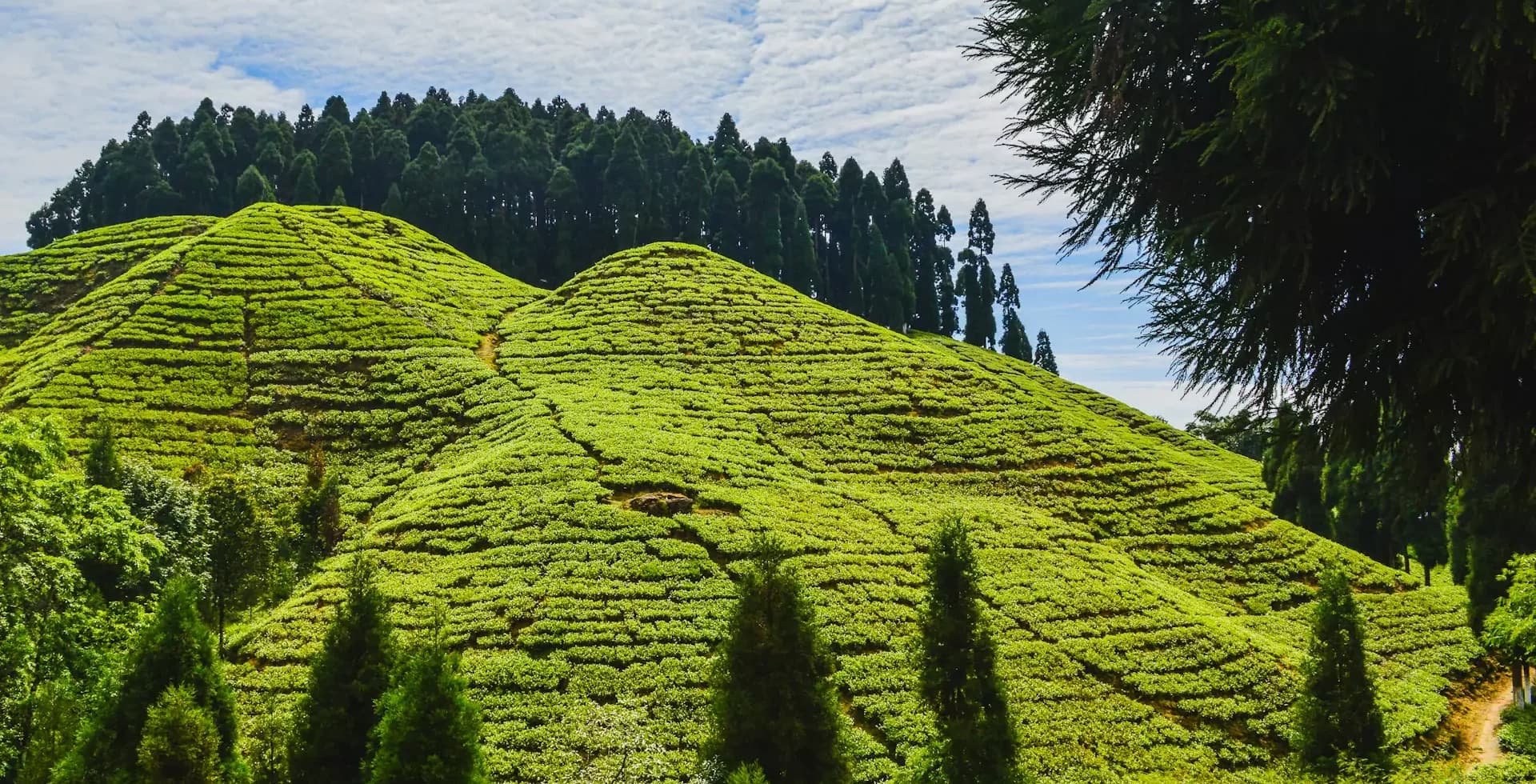
Darjeeling - today a world-famous tea mecca - was, until the mid-19th century, just a forgotten spur of the mountains overgrown with forest. This remote corner of India was transformed only by the British passion for tea.
The first “experimental” tea plant was planted here in 1841 by the Scottish physician Dr Archibald Campbell. It was he who discovered that the fresh, misty air and steep slopes of Darjeeling are ideal for the delicate Chinese tea plant (Camellia sinensis var. sinensis).
In the 1840s China had practically a complete monopoly on tea, Britain was heavily dependent on imports and prices were rising. The British East India Company therefore decided that if they could not legally grow tea, they would “obtain” it in secret.
In 1852 the first experimental gardens Tukvar, Steinthal and Alubari were established with several thousand plants. A few years later the expert Robert Fortune arrives, who was chosen to undertake a secret journey into the heart of the Chinese tea regions - at that time absolutely forbidden to foreigners. Disguised as a Chinese man, with a shaved head and in traditional dress, he reached areas where not even foreign merchants were allowed, and quietly began to gather not only plants and seeds of the tea plant (Camellia sinensis), but also precise knowledge of tea cultivation, processing and fermentation.
To escape attention and survive the long voyage, he used the invention of the “Wardian case” - a glass mini-greenhouse that kept the humidity and protected the seedlings from salt water and mould. Thanks to it, Fortune exported thousands of young plants, seeds and tea-processing equipment directly from China. Not everything went according to plan - during transport to India, officials in Calcutta opened some of the glass crates and many plants died. Nevertheless the rest survived and became the basis for new plantations in Darjeeling and Assam.
Fortune also gained the knowledge that black and green tea come from the same plant, the difference being only in the processing (oxidation vs. non-oxidation).
The result of his “industrial espionage” was an enormous economic change: India and Ceylon (Sri Lanka) became tea powers and Britain was no longer dependent solely on China. Fortune was forever recorded among the greatest botanical adventurers and “tea spies” of the world.
From 1856 the commercial era begins - records speak of the first tea gardens, which quickly spurred a boom across the whole region.
As the tea plantations grew, Darjeeling needed a workforce: Nepalis, Lepchas and other local communities came to the slopes. Their hands, skill and traditions became the backbone of the tea legend.
By 1866 there were already 39 gardens and Darjeeling was exporting its fragrant treasure to the world.
By the end of the 19th century this tea was known as the “Champagne of teas”. Its unique “muscatel” aroma and fresh, floral character had no competition in the world.
In the 20th and 21st centuries new challenges arrived: preserving the original flavours, ecological agriculture, the loss of the Russian market after the collapse of the USSR. Darjeeling gardens began to obtain organic and fair-trade certificates, and the tea is overseen by a special Indian “tea board” - only tea grown in registered gardens may carry this name.
A special climate: Misty mornings, cool nights, abundant rainfall and fertile soil.
Traditional hand-picking of only the youngest of the top leaves.
Several harvest periods: Spring brings delicate teas (first flush), summer full of aroma (second flush), autumn riper and sweeter notes.
The quality and taste of Darjeeling is tied to three main harvest seasons:
First flush (spring): late February to mid-April - the most fragrant and delicate teas, only briefly oxidised (10-30%).
Second flush (summer): the second half of May - a fuller body, higher oxidation (60-80%), more pronounced fruity notes.
Autumnal flush (autumn): after the monsoon - quality but less prized teas, a specific character, longer shelf life
Winter flush (winter harvest): an extremely rare and lesser-known “fourth” harvest of tea leaves, which takes place after the end of the main autumnal-flush season, i.e. in the winter months - usually in December to January. The taste of the resulting tea tends to be markedly delicate, in some cases even sweetish, with elegant, sometimes almost “honeyed” notes.
To this day Darjeeling tea is among the most sought-after and also the most imitated teas in the world - but the true essence springs only from the rocky slopes of the Himalayas. It is a tea with the soul of a story and the wealth of generations who continue to write it together to this day.